FanAir News - Info- Blog Posts
Important considerations and facts when deciding which Blower and Blower Motor is the best for any application:
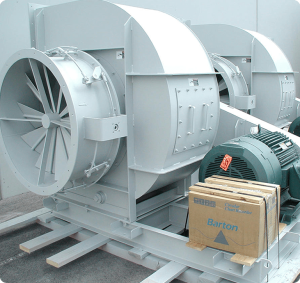
We welcome the opportunity to work with you and your specifications to design and build an efficient Air-System component part specific to your requirements.
1) The least cost Industrial Centrifugal Blower is not necessarily going to be the least cost Blower. It is widely known that in comparing a few Blower selections that a smaller Blower might be the least initial cost to purchase, however taking into consideration the operating costs, and the high cost of 3 Phase Industrial Power, the smaller least cost blower may well cost more in the long term in energy use. This is based upon mechanical operating efficiency, and the Blower’s Motor Size.
2) A Centrifugal Blower selection with a lower cost, will often operate at a higher operating RPM and Tip / Rim Speed, resulting in a higher noise rating often with a higher decibel level in the higher frequency ranges. Often noise levels in the higher octave band levels at 1000 Hertz and above are more objectionable and may lead to complaints or code violations. Consideration of the overall noise level at the owner’s property line is very important. FanAir Co offers many types of silencers and sound enclosures to mitigate noise produced by industrial blowers.
3) Additionally close attention needs to be given to the Air System Design and Ductwork attached to the Blower. It is extremely critical to design the ductwork entering and exiting a Centrifugal Industrial Blower to have a minimum of air turbulence. Avoid placing elbows at the Blowers intake or discharge. Blowers typically need sections of straight duct as a minimum of 3 duct diameters away from the inlet or discharge. Improper duct design can lead to a system effect which is a static pressure loss that is unpredictable.
4) When requesting a selection and proposal for an industrial Blower, always inform the sales engineer, as a minimum of the following critical information on the application:
a) Indicate the intended purpose of this Blower? IE: Dust Collection, Oven Exhaust, Forced Draft Air System, Decarbonator, Air Stripper, Fume Scrubber, Thermal Oxidizer, Biofilter etc.
b) Indicate the quantity of Air Volume Requirements. IE: ACFM, SCFM, Lbs/Hr, Cubic Meters per Minute, Etc.
c) Indicate what the System’s Total Static Pressure Requirement is. It is typically the system designer’s responsibility to calculate the Static Pressure in the system, including all ductwork, dampers, filters, scrubber, etc. and or any appurtenance in the ducted system.
d) Indicate what the air make up is and at what operating temperature, and at what minimum and maximum air temperature will be. Additionally specify what the elevation will be at the point of installation. If known, specify what the inlet air density will be in terms of Lbs/Ft3. If the air is a mixture of gases, specify and list the gases and what % by volume is expected. A good Blower application sales engineer professionally trained can make the inlet density calculation based on the molecular weight of a mixture of gases and determine the inlet density based on conditions above.
e) Indicate the Area of Classification the Blower and Blower Motor will be installed into. If not classified, indicate not classified, otherwise indicate Class, Division, and Group, as applicable or as indicated in the specifications. Specify if the Blower is required to have AMCA Spark Resistant Construction, Type A, B, or C. See AMCA Guide to spark resistant construction.
f) Indicate what accessories are required, common accessories are Control Dampers, Access Doors, Shaft Seals, Special Coatings, Vibration Isolators, Inertia Bases, Bearing Temperature Detectors, OSHA Safety Guards, Inlet Boxes, Discharge Transitions or Evase’s, abrasion resistant materials and linings, heat fan construction, split housings, Inlet or Discharge Silencers, or special swing out design allowing access to impeller for inspection and replacement without disturbing the ductwork.
g) Indicate what type of Motor enclosure is required. IE: Open Drip Proof ODP, Totally Enclosed Fan Cooled, Severe / Chemical Duty, Explosion Proof, IEE45, etc.
h) Indicate the facility’s power requirements, IE: Single Phase, or Three Phase, and at what Voltage: IE: 110V, 230V, 460V, 575V, 2300V, 4160 V Etc.
i) Indicate if known, what the Maximum Noise Level Requirement is at the Property line.
Given the above complete details and disclosures, the Blower application engineer should be able to provide an accurate proposal for the best and most efficient Blower selection that meets the needs of the facility owner.
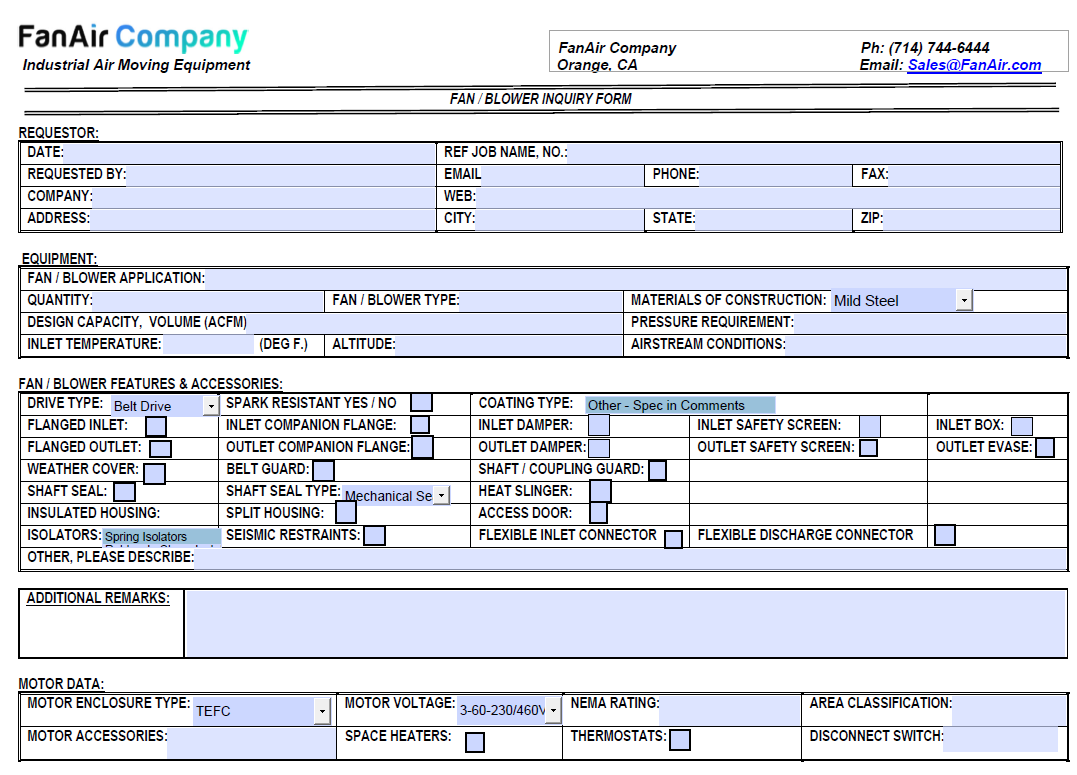
Fan / Blower Inquiry form on Acrobat
Acrobat Easy to use Form for quick Price and Blower Selection
Please contact FanAir Co today for a custom Blower selection and price quote that meets the specific needs on your next industrial air moving system.
This article was written by Scott F Sneller, Owner / Engineer at FanAir Co., LLC. Mr. Sneller has over 45 years of experience in the design, application, sales and manufacturing of Industrial Fans, Blowers, Electrical Motors, Industrial Ducting Systems, Air and Fume Filtration and Scrubbing Systems.